Queen's University capstone
Laboratory Wind Generator for Replication and Control of Real-World Wind Conditions
We designed a laboratory wind generator that could replicate real world wind conditions, varying flows spatially and temporally, to be used in the Queen's University fluids lab.
Demonstration
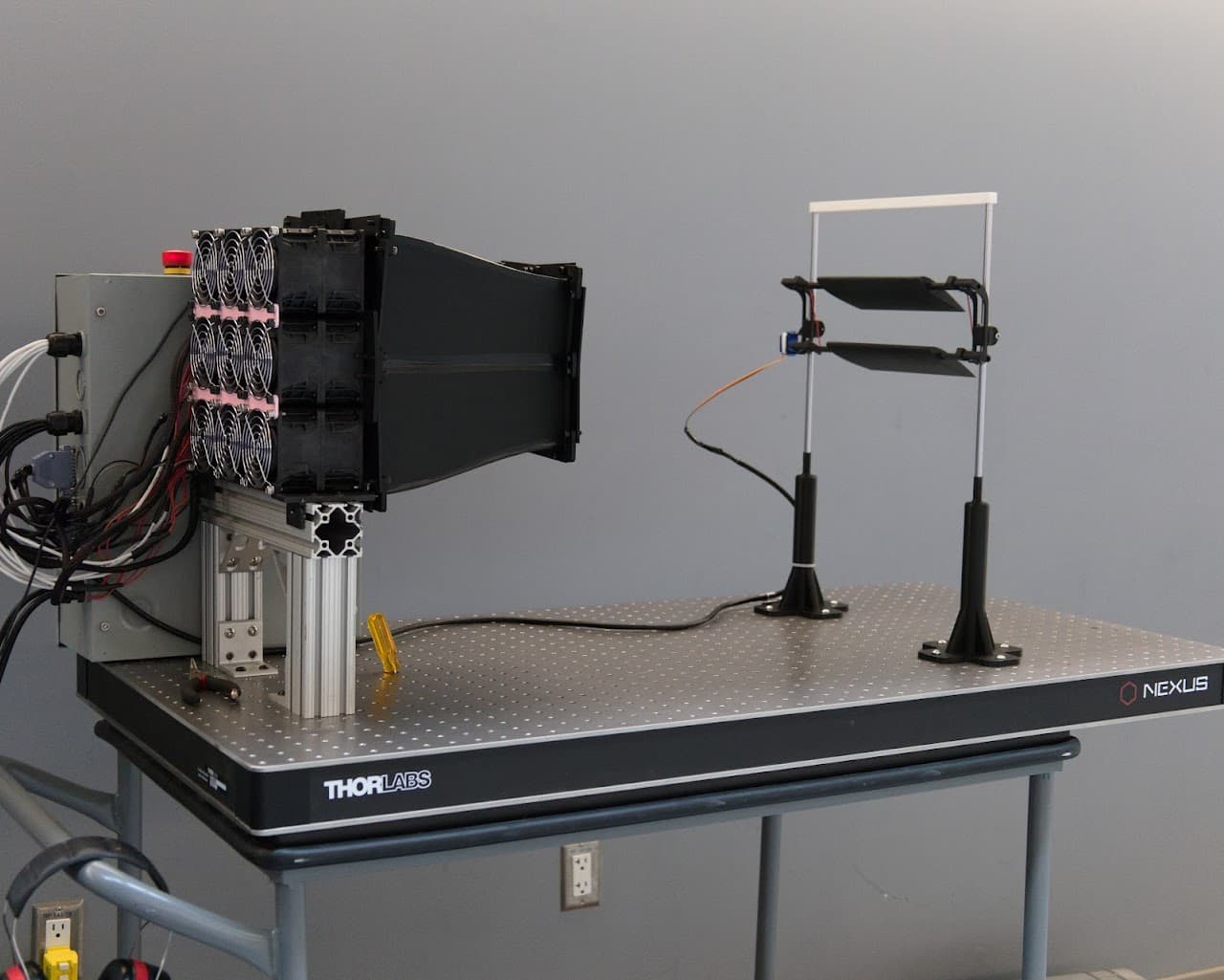
Mini mobile laboratory wind generator with biplane airfoil demonstration at Queen's University Mechanical Engineering Design Exhibition, 3/29/25
Demonstration of airfoil wind surfing in lab, operating at high speed and unsafe noise level. Hearing protection required (video is loud!) First 17 seconds worth watching!
During the fall term, we inherited a 9x9 array of fans that was extremely unsafe to operate due to electrical issues. During the semester, we re-designed the electrical and control systems for the fans, and developed a lab integration method taking into account the existing lab system.
I designed the system integration, incorporating 95%+ off the shelf parts, enabling easy maintenance, modulation, and future adaptation. The final design provided cost savings of 66%, saving $50,000 compared to commercial alternatives.
In the Winter term, we designed and implemented a mobile and scaled down 3x3 model. This allows our clients to bring the device outside of their lab for use in demonstrations, such as presenting papers at conferences or inspiring fluid mechanics interest at high schools. Additionally, it gave us an opportunity to implement a scaled down version of the electrical and control system created for the 9x9 array.
Control system
I designed the user control interface in LabVIEW, communicating over serial to embedded microcontrollers. The program allows manual control of all 9 fans independently, or allows file input to create premade profiles.
Fluid demonstration
Additionally, we created a fluid demonstration model that demonstrates lift. It consists of a dual wing airfoil inspired by WW1 planes, vertically mounted on linear rods. The device has an adjustable angle of attack, allowing demonstration of stall or lift efficiency.
I iterated many times on the airfoil mounting system, making changes to reduce weight, mitigate vibration and misalignment, improve balance, and incorporate a second airfoil to improve lift. I designed the contraction device to increase velocity amid very restrictive noise level limits and consequently operational velocities.
Back to the hand project
← Home